Method
WarpSAC is a controlled extension of FlashSAC that separates replay-side exploitation from network-side stabilization. Its main replay component, Sample Weight Decay (SWD), assigns each transition an age-dependent sampling weight. Recent, policy-relevant data are sampled more often, while older transitions retain a nonzero weight for coverage. SWD changes only the minibatch distribution; it introduces no auxiliary network, Bellman target, or loss term.
Parameter projection normalization is the profile-level distinction between the two workload settings. It renormalizes network parameters after each optimizer step, constraining the effective function class and reducing unstable value extrapolation. WarpSAC-L enables normalization for CPU-scale training, while WarpSAC-A disables it for GPU-parallel training. Both profiles use the same SWD replay mechanism; the profiles do not represent different replay buffers or different state-action-pair coverage assumptions.
| Profile | Configuration |
|---|---|
| WarpSAC-L | CPU-scale profile: SWD, Norm ON, clipped double-Q |
| WarpSAC-A | GPU-parallel profile: SWD, Norm OFF, single-Q |
| Automatic profiles | Defaults are resolved from the environment type and workload scale |
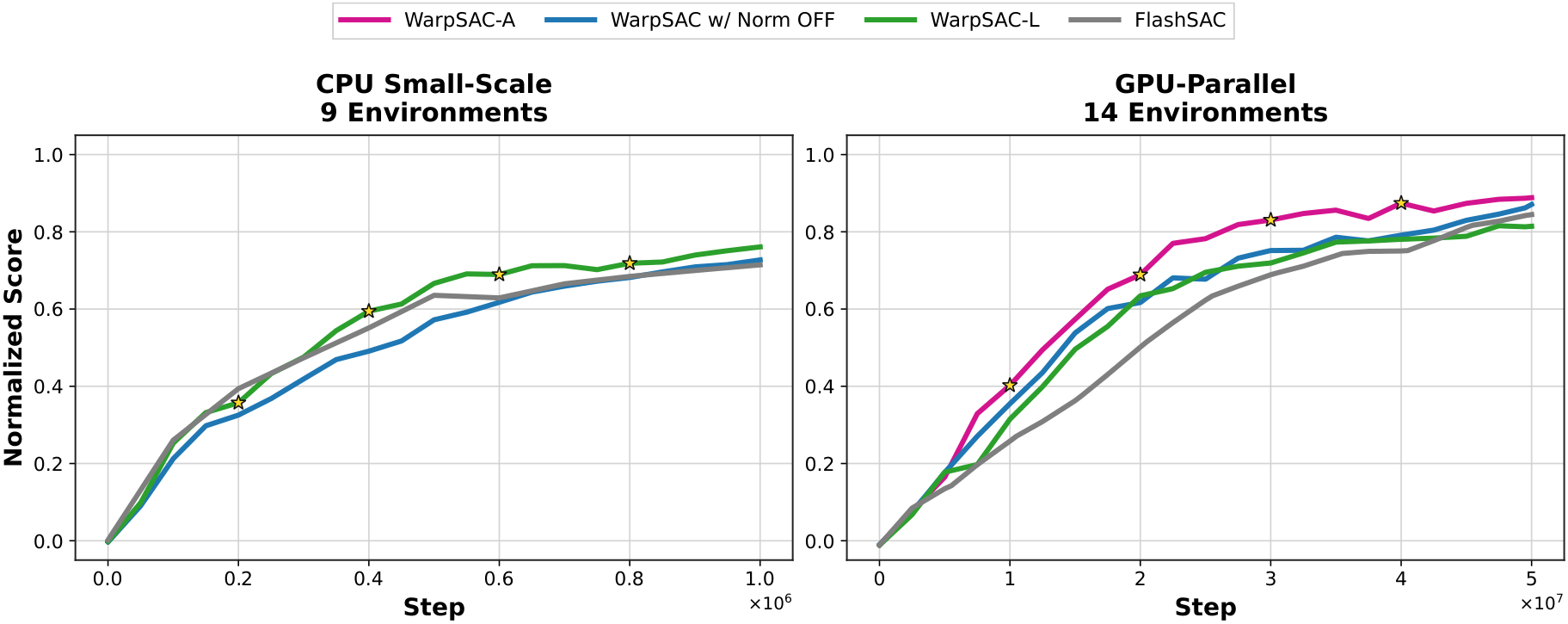
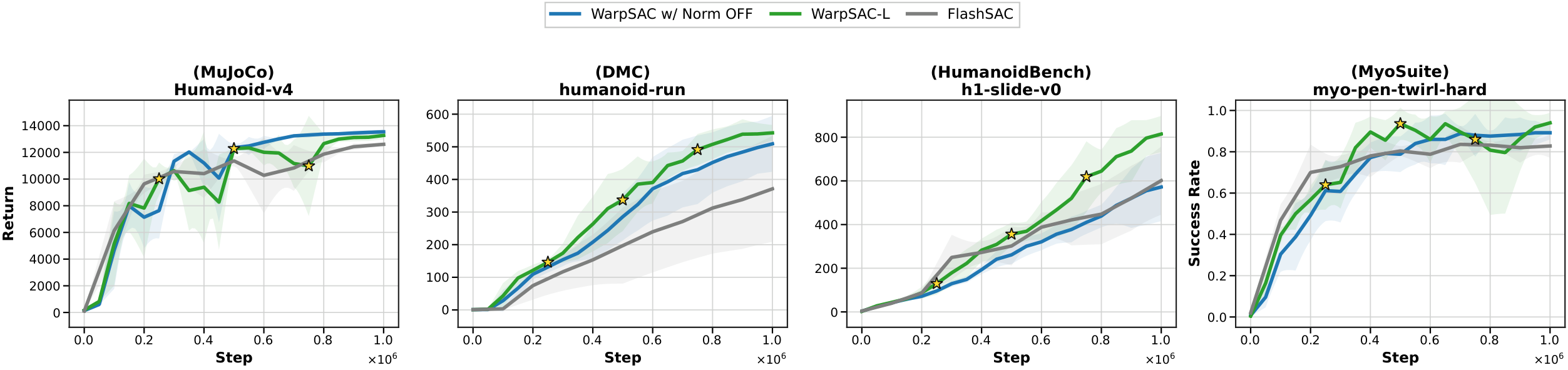
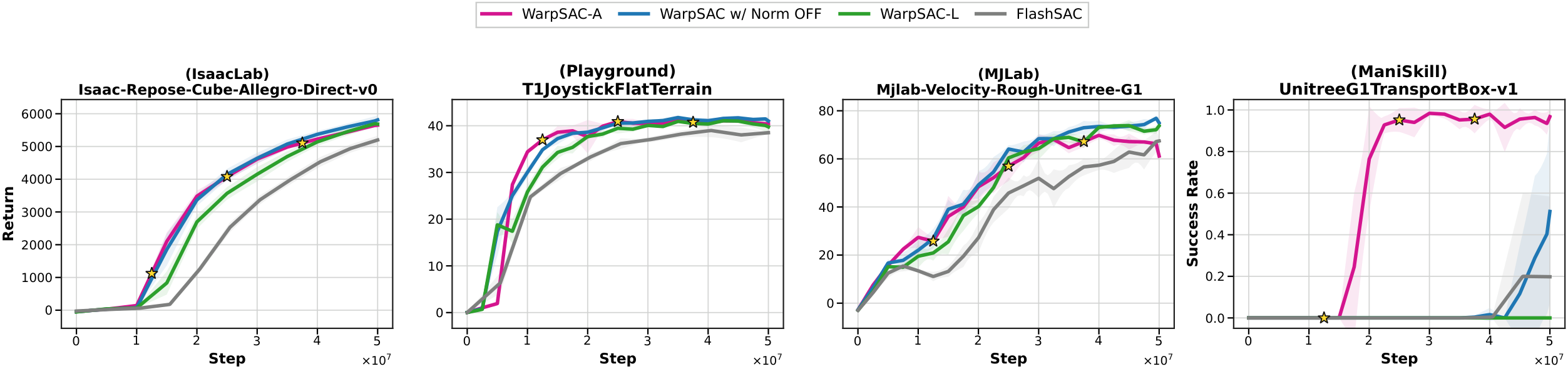
Figure 2. Combined CPU-scale and GPU-parallel learning curves. We recommend WarpSAC-L for CPU-scale training and WarpSAC-A for GPU-parallel training.